


A few days ago, while browsing Anthropic’s API docs, I noticed an entirely new section in the sidebar: “Managed Agents.”
Clicking through, it wasn’t another prompt management tool or some new SDK wrapper — it was a full hosted agent execution infrastructure. You define the agent’s brain, they handle the hands — sandboxing, state, security, scaling, all of it.
“Pre-built, configurable agent harness that runs in managed infrastructure.”
My first reaction: isn’t this basically Heroku for agents?
What You Used to Build Yourself
If you’ve ever tried pushing an AI agent from prototype to production, you know the pain. The model call itself is the tip of the iceberg, what actually eats your time is:
- Sandbox environment: agents need to run code, so you need a secure container
- State management: agent crashes mid-run — how do you recover from the checkpoint?
- Credential security: agents need external service access, where do you put API keys so agent-generated code can’t steal them?
- Observability: what did the agent do? Why? How long did it take?
- Scaling: one agent runs fine, what about a hundred simultaneously?
Add it all up and a two-week agent prototype routinely takes months to actually ship, right?
Claude Managed Agents tackles this entire layer.
Four Core Concepts
Anthropic breaks Managed Agents into four concepts:
| Concept | You Handle | Anthropic Handles |
|---|---|---|
| Agent | Model, system prompt, tools, MCP servers | — |
| Environment | Specify packages, network rules | Container creation, isolation, security |
| Session | Send tasks, receive results | Execution loop, state persistence, error recovery |
| Events | Send user turns, process responses | SSE streaming, event history persistence |
Once your agent is defined, you open a session via API, send a message, and Claude autonomously executes inside a cloud container — running Bash, reading and writing files, searching the web, calling MCP servers — streaming results back via Server-Sent Events. You can even send new instructions mid-execution to steer the agent, or interrupt it entirely.
”Decoupling Brain from Hands” — OS-Level Architecture
This is the part I find most worth examining. Anthropic’s engineering team published a companion piece, “Scaling Managed Agents: Decoupling the brain from the hands,” explaining their architectural philosophy.
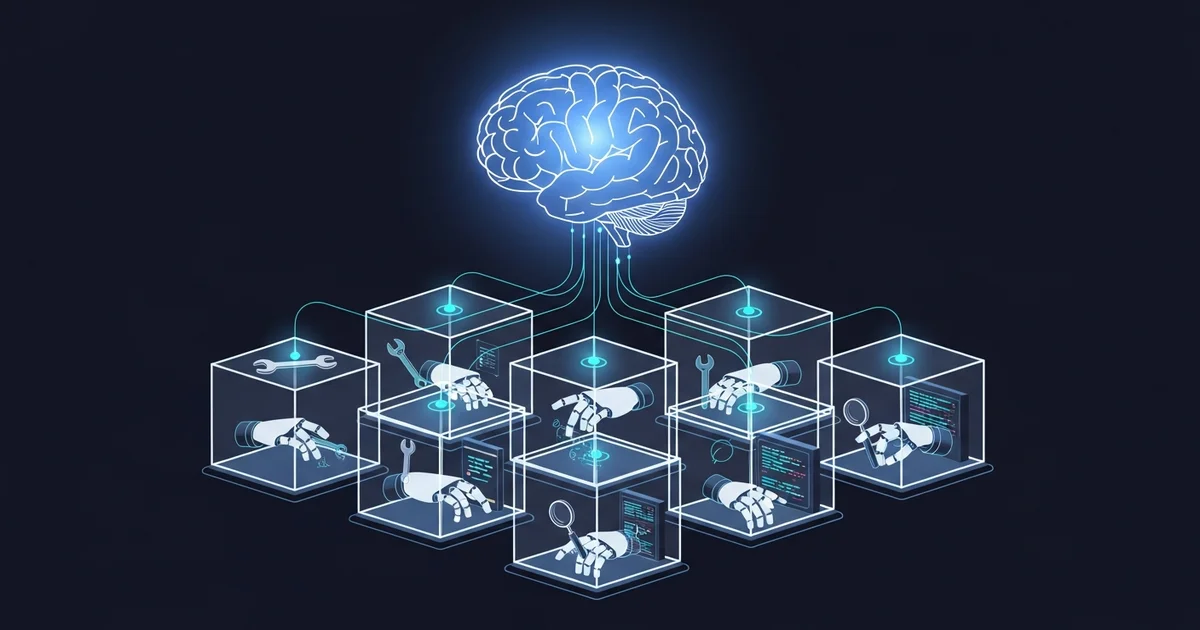
The traditional approach puts an agent’s reasoning engine (brain) and execution environment (hands) in the same container, which means: container dies, agent state is gone; container boots slowly, agent waits; containers compete for resources, scaling becomes a nightmare.
Managed Agents decouples three components entirely:
- Session: An append-only event log recording everything the agent has done. Exists independently of any container.
- Harness: The control loop that calls Claude and routes tool calls. Stateless, horizontally scalable.
- Sandbox: The container where agents run code. Treated as “cattle” — breaks, get a new one via
provision({resources}), provisioned on demand.
The result? Time-to-first-token reduced by ~60% at p50, over 90% at p95. If the harness crashes, wake(sessionId) brings it back; if the container dies, the session log survives, spin up a new container and continue.
Their exact words: “The harness doesn’t know whether the sandbox is a container, a phone, or a Pokémon emulator.”
If you’ve read our Architecture Isn’t the Point, Context Is, there’s an interesting parallel here: Managed Agents treats the Session as a queryable memory store outside the context window. When long-running tasks exceed the window, the harness can selectively rewind and re-read via getEvents() — context management becomes an infrastructure-level concern, no longer your prompt engineering problem.
Security Design
This part I think is elegantly done: credentials never enter the sandbox.
- Git tokens are bound during container initialization — Git operations work, but agent-generated code can’t touch the tokens
- OAuth and MCP tool credentials live in an external vault, retrieved through a dedicated proxy
Even if an agent writes malicious code, it can’t steal your API keys. This is a baseline requirement for production, but remarkably easy to overlook when building your own stack.
Pricing
| Item | Cost |
|---|---|
| Model tokens | Standard API pricing |
| Agent runtime | $0.08 / session-hour (billed per millisecond, idle time excluded) |
| Web search | $10 / 1,000 searches |
Eight cents an hour for agent execution — honestly, that’s cheap. If you’re running EC2 or Cloud Run to host agent sandboxes, the container costs alone exceed this, not to mention the orchestration, checkpointing, and error recovery you’d build yourself.
Who’s Already Using It?
| Company | Use Case |
|---|---|
| Notion | Delegating tasks to agents directly within workspaces |
| Rakuten | Enterprise agents for sales, marketing, finance, integrated with Slack/Teams — deployed in under a week |
| Asana | Productivity and task automation |
| Sentry | Debugging agent + auto-patch writing + PR creation |
Rakuten’s one-week deployment is the most compelling number — if you know how long enterprise AI integrations typically take.
Features Still in Research Preview
Three features require separate access:
- Multi-agent: Agents can spawn other agents for complex subtasks
- Outcomes: Automatic response quality evaluation and improvement (“improved task success by up to 10 points over standard prompting loops in internal testing”)
- Memory: Cross-session memory management
The multi-agent feature is particularly interesting — it maps directly to the scenarios discussed in Agent Team: When Subagents Aren’t Enough — except this time, Anthropic manages the orchestration for you.
My Take
Maybe the biggest significance of Managed Agents isn’t the technology itself, but that it announces the birth of a new category: Agent-as-a-Service.
Think back to what Heroku did in 2007: you didn’t need to manage servers, just git push to deploy. Over a decade later, Managed Agents does something similar at the agent layer — no need to build your own sandbox, write orchestration loops, or handle checkpointing, just define your agent’s capabilities and leave the rest to the platform.
But the limitations deserve equal attention: it currently runs exclusively on Anthropic’s own infrastructure, with no availability through AWS Bedrock or Google Vertex AI. This is a strategic choice — Anthropic clearly wants to keep developers in their ecosystem — but for enterprises requiring multi-cloud deployment, this is a lock-in risk that demands evaluation.
And it only supports Claude models. If your agents need to switch between GPT and Claude across different scenarios, Managed Agents can’t accommodate that today.
Perhaps the most practical advice: if you’re building a new agent system from scratch, have a small team, and primarily use Claude, Managed Agents can eliminate massive amounts of infrastructure engineering. But if you already have a custom agent framework or need model flexibility, watching from the sidelines may be the steadier choice.
Regardless of your decision today, one thing is certain: agents moving from “build it yourself” to “let the platform handle it” — that road is now officially open.
References
- Claude Managed Agents official docs: https://platform.claude.com/docs/en/managed-agents/overview
- Anthropic Engineering Blog — Scaling Managed Agents: Decoupling the brain from the hands: https://www.anthropic.com/engineering/managed-agents
- SiliconANGLE — Anthropic launches Claude Managed Agents: https://siliconangle.com/2026/04/08/anthropic-launches-claude-managed-agents-speed-ai-agent-development/
- The Decoder — Anthropic launches managed infrastructure for autonomous AI agents: https://the-decoder.com/anthropic-launches-managed-infrastructure-for-autonomous-ai-agents/
- 9to5Mac — Anthropic scales up with enterprise features: https://9to5mac.com/2026/04/09/anthropic-scales-up-with-enterprise-features-for-claude-cowork-and-managed-agents/
- Help Net Security — Claude Managed Agents bring execution and control: https://www.helpnetsecurity.com/2026/04/09/claude-managed-agents-bring-execution-and-control-to-ai-agent-workflows/
Support This Series
If these articles have been helpful, consider buying me a coffee