


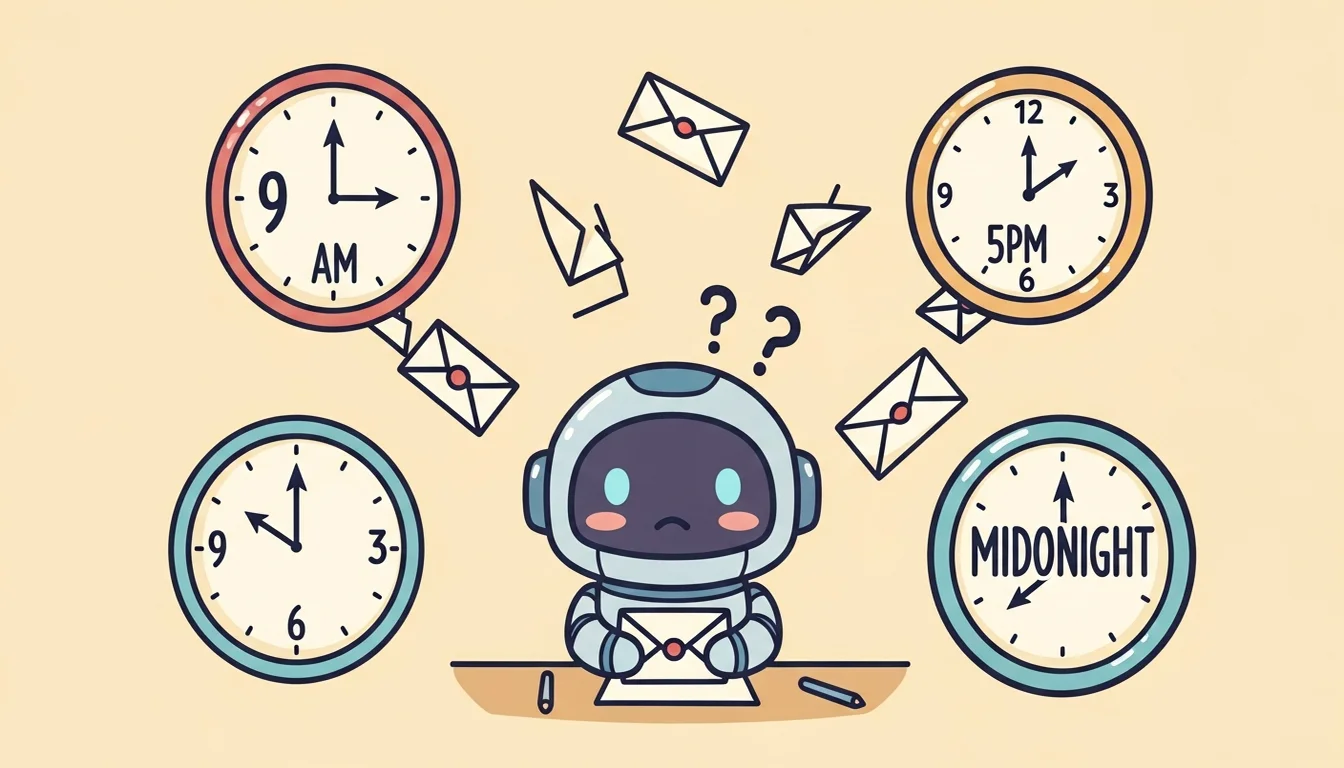
Last time we talked about how Agents lose details when reading with summarization. This article covers something even more insidious: an Agent silently made an assumption you didn’t know about, and that assumption quietly, gradually, wrecked your work.
A Daily Agent That Just Worked
Our company’s team spans three to four timezones — Taiwan, Japan, US West Coast, US East Coast. Daily email volume is significant, and manually reading and categorizing everything would eat an entire morning.
So I built an Agent that runs every morning to:
- Fetch all work emails from the last execution checkpoint to now
- Summarize each email’s key points, action items, and progress updates
- Distribute project-relevant content to each project’s dedicated Agent
- Generate a “daily overview” for me
It works like a dispatcher — routing the right information to the right place. This workflow ran smoothly for a while, and I thought it was great.
Until one day, while manually replying to an email, I noticed: a colleague had sent me something two days ago that the Agent never mentioned.
How an 8-Hour Error Became 25 Hours
Digging in, the problem became clear: the Agent used Taiwan’s timezone as the basis for all operations.
Each time the Agent runs, it records a “checkpoint time,” and the next run fetches emails from that point forward. Sounds reasonable, right?
The problem: when your emails come from the US West Coast (UTC-8) but the Agent records checkpoints in Taiwan time (UTC+8), there’s a 16-hour gap. An email sent at 11 PM Pacific would be 3 PM the next day in Taiwan. If the Agent’s checkpoint was set to Taiwan midnight, that email gets skipped.
This isn’t unique to my setup. An analysis of OpenCLAW’s timezone handling [4] shows that LLMs have no internal clock — when VMs run on UTC (the cloud default) and the user is in a different timezone, agents greet you with “good morning” at 9 PM and think today is yesterday. Fixing it requires aligning four separate layers: system timezone, gateway environment, app config, and agent-level instructions.
But it doesn’t stop there. The error isn’t one-time — it compounds with every execution.
Specifically, the Agent runs at 9 AM daily and records the checkpoint as “today 09:00 UTC+8.” Next run, it queries “emails after last checkpoint.” But the Gmail API returns timestamps in the sender’s local time — an email sent at 5 PM Pacific (UTC-8) has a timestamp of 17:00 PST, which converts to 9 AM Taiwan time the next day. If the Agent doesn’t normalize everything to UTC before comparison, this email lands right on the checkpoint boundary — it might get skipped or double-counted.
The critical issue: each boundary error doesn’t self-correct — it drifts in the same direction. Day one misses an 8-hour window (the gap between Taiwan late night and US West Coast end-of-day). Day two, the window expands to 16 hours as the checkpoint advances. Day three, it’s past 24 hours.
By the time I caught it, the gap had accumulated to 25 hours — roughly one to two days of work that silently disappeared. And because it exceeded a full day, the missing items were no longer just edge-case boundary emails — they were entire working days of communication. An analysis of international SaaS timezone edge cases [8] describes the exact same phenomenon: “The bug’s insidious nature lies in its ability to propagate errors silently and unnoticed, with initial offsets compounding over time.”

Why Didn’t the Agent Notice?
This is the part that really got me.
The Agent fetches my sent mail copies every day. In those sent copies, some replies quote incoming emails that the Agent never indexed — meaning my own replies referenced emails the Agent had no record of.
The evidence was right there. If the Agent had carefully read each sent mail copy’s full content, it should have flagged: “This reply quotes an original email that isn’t in my index.” That’s an obvious anomaly.
But it didn’t.
Why? Same reason as Tips 3 — Agents read everything with summarization. To the Agent, quoted content in sent copies is just “previous correspondence.” Unless there’s a specific reason to investigate, it won’t expand and read the quoted sections. They get treated as low-priority duplicate content and skipped.
So the Agent not only missed emails — it didn’t even know it was missing emails.
A study on silent failure in Agent orchestration [5] captures this precisely: “LLM outputs look authoritative — clean prose, logical structure — but nothing signals where errors were introduced.” Most frameworks rely on prompt-level “double check the previous step” rather than structural validation. Research on multi-agentic trajectories [7] confirms that such silent failures are only detectable through dedicated external monitoring systems.
To be fair, this doesn’t mean Agents can never self-detect. If the design had included a dedicated verification Agent from the start — one that cross-references the index against sent-copy references, checks timezone boundary coverage — this problem could have been caught automatically. The issue isn’t that Agents can’t do it, but that without a pre-designed checking mechanism, they won’t think to do it on their own. That “pre-design” itself requires a methodology, which we’ll cover in the upcoming articles.
But in my case, I hadn’t designed such a mechanism. So a human caught it.
How Did a Human Catch It?
The dumb way: I read my own email manually.
While replying to something one day, I noticed colleagues discussing a decision I knew nothing about. Checking my inbox revealed the entire discussion thread had never been picked up by the Agent.
That triggered a full audit.
The Fix
Tracing back, the problem had two layers:
Layer one: timezone handling. Checkpoint times must be recorded and compared in UTC, not local time. Month assignment can’t rely on displayed timestamps alone — an email showing 2022-06-01T00:39:28+08:00 might have been sent on May 31st US Pacific time. Whether it belongs to May or June depends on the Gmail query result set, not the timestamp’s face value. A guide on timezone handling in cron jobs [11] also notes that DST transitions cause jobs to run early, duplicate, or skip entirely — cron has no built-in DST support.
Layer two: filter rules. The audit also revealed that email filter rules were too broad — they were supposed to filter by sender and subject only, but the actual implementation also checked message body content, causing legitimate work emails to be incorrectly excluded when their body text mentioned certain keywords.
Together, these two issues meant: some emails were skipped due to timezone, others were killed by filters, and the Agent noticed neither. A case study of an AI Agent’s 6-hour silent downtime [10] describes an almost identical scenario: the health check ran 180 times, each logging “warning” but never escalating — 47 delayed messages, 3 unresponsive conversations, a system “operational but not effective.”
The fix established a set of audit rules:
- Compare email ID sets first — don’t look at content, verify count and ID consistency
- Treat timestamp display differences as secondary — cross-timezone display variations don’t indicate crawl errors
- Filter rules: sender and subject only — never touch message body
- Gmail query results are the sole authority for month assignment — not stored timestamps

Implicit Assumptions Are the Most Dangerous Bugs
Looking back, the root cause wasn’t a code error — it was an implicit assumption: the Agent assumed all work happens in one timezone.
This assumption wasn’t written anywhere. You won’t find “please use Taiwan time for all emails” in any prompt. It’s what the Agent naturally defaulted to during implementation — because the person who built it was in Taiwan, the session’s system time was UTC+8, so all time calculations used UTC+8.
Agents don’t question their own assumptions. It won’t ask you: “How many timezones does your team span?” It won’t check while fetching: “What’s the timezone distribution of these senders? Does my fetch window cover all of them?”
This is another variant of the “known trap” from article thirteen — the Agent treats environmental conditions observed during its session as universal facts, then executes all subsequent work based on those “facts.”
It’s Not Just About Timezones
The implications extend beyond timezones. Any Agent can hit similar traps in these scenarios:
- Scheduled tasks — Agent assumes your workweek is Monday through Friday, but some team members work Saturdays
- Language processing — Agent assumes all emails are in English, but some internal communication is in Chinese
- API calls — Agent assumes API responses use UTC, but some APIs return server-local time
- File paths — Agent assumes you’re on macOS, but the project’s CI runs on Linux
The common pattern: Agents derive a set of assumptions from the environment they were built in, then treat those assumptions as permanent, universal truths.
A paper analyzing why multi-agent LLM systems fail [6] found that “proceeding with wrong assumptions instead of seeking clarification” accounts for 6.8% of multi-agent coordination failures. LLMs accept flawed input uncritically, lacking context-aware intuition to challenge peer information. Stack Overflow Blog’s analysis [12] also notes that AI generates 1.7x more bugs than humans, with 75% more logic errors — and implicit assumptions are a major source of logic errors. A Cloud Security Alliance report [13] reveals that only 21% of organizations maintain a real-time Agent registry, meaning most teams don’t even know what assumptions their Agents are making.
My Take
Perhaps the most important takeaway from this case isn’t the timezone technicalities, but two things:
First, Agents don’t tell you what assumptions they’ve made. You have to actively think: “What environment was this Agent built in? What conditions might it have assumed as defaults?” This is different from debugging code — code bugs throw errors, but assumption bugs execute silently until the consequences become too large to ignore.
Second, Agents don’t self-verify. Even with evidence of missed emails sitting right in the sent copies, it didn’t cross-check. This isn’t a capability issue — if you explicitly tell it “compare your indexed emails against references in sent copies,” it can do it. But it won’t think to do it on its own.
A 25-hour gap, accumulated over several days, finally caught by a human who happened to be manually replying to email.
Maybe this is what demands the most vigilance in Agent collaboration right now: the smoother and quieter an Agent runs, the more you need to periodically spot-check what it’s actually doing. Because truly dangerous problems never announce themselves.
But “periodic spot-checking” isn’t a long-term solution. If you truly want Agents to run autonomously, what you need isn’t a more careful Agent — you need another Agent to check it. An independent verification mechanism with a clear methodology, knowing what to check, how to check it, and what level of deviation should trigger an alert.
That’s what the next three articles will cover: how to distill methodology from experience, how to turn methodology into an Agent-executable Playbook, and how to turn a Playbook into a reliable execution plan. Because every pitfall in this article — timezone blind spots, summarization gaps, implicit assumptions — can be systematically prevented, as long as you’re willing to first turn “how to prevent it” into a methodology of its own, then land it as a System.
References:
[1] Practical Tips 3: The Agent Reading Trap — Detail loss from Agent summarized reading /en/articles/15-tips-agent-reading-trap
[2] Practical Tips 1: The Agent’s “Known” Trap — Agents treating session context as implicit knowledge /en/articles/13-tips-agent-context-trap
[3] Article 3: Context Engineering — Context precision determines Agent quality /en/articles/3-context-engineering
[4] AI Agents Getting the Date Wrong? — NZ365Guy — LLMs have no internal clock, timezone requires four-layer alignment https://nz365guy.com/blog/ai-agents-timezone-configuration-openclaw
[5] Agent Orchestration Failure Modes: Silent Drift — Silent failure between agents and lack of structural validation https://glenrhodes.com/agent-orchestration-failure-modes-silent-drift-reconciliation-and-the-supervision-mindset-shift/
[6] Why Do Multi-Agent LLM Systems Fail? — arXiv — 6.8% of multi-agent failures from “proceeding with wrong assumptions” https://arxiv.org/abs/2503.13657
[7] Detecting Silent Failures in Multi-Agentic AI Trajectories — arXiv — Silent failures detectable only with external monitoring https://arxiv.org/html/2511.04032v1
[8] Timezone Edge Cases in International SaaS — DEV Community — Timezone offsets compound on every save/reload cycle https://dev.to/tomjstone/international-saas-nightmare-timezone-edge-cases-and-how-to-solve-them-once-and-for-all-57hn
[9] Google AI Overview Has a Timezone Bug — Shekhar Gulati — Google AI misidentified Saturday as Friday due to PST/IST offset https://shekhargulati.com/2025/03/23/google-ai-overview-has-a-timezone-bug/
[10] AI Agent Silent Failures: 6 Hours of Undetected Downtime — DEV Community — Agent ran empty queue for 6 hours, 180 health checks never escalated https://dev.to/bobrenze/ai-agent-silent-failures-what-6-hours-of-undetected-downtime-taught-me-about-monitoring-3ja8
[11] Handling Timezone Issues in Cron Jobs — DEV Community — DST transitions cause jobs to run early, duplicate, or skip https://dev.to/cronmonitor/handling-timezone-issues-in-cron-jobs-2025-guide-52ii
[12] Are Bugs Inevitable with AI Coding Agents? — Stack Overflow Blog — AI generates 1.7x more bugs than humans, 75% more logic errors https://stackoverflow.blog/2026/01/28/are-bugs-and-incidents-inevitable-with-ai-coding-agents/
[13] The Visibility Gap in Autonomous AI Agents — Cloud Security Alliance — Only 21% of organizations maintain a real-time Agent registry https://cloudsecurityalliance.org/blog/2026/02/24/the-visibility-gap-in-autonomous-ai-agents
Support This Series
If these articles have been helpful, consider buying me a coffee